A staffing firm’s year-end close means reconciling bank accounts, receivables, payables, timesheets, invoices, commissions, and intercompany balances so every dollar lands in the correct period. The fastest route to a clean close is a fixed checklist, a timesheet-to-invoice check for unbilled revenue, and an audit trail for every entry.
What Is a Year-End Financial Close for Staffing Firms?
A year-end financial close is the process of reviewing, reconciling, and finalizing all financial records so revenue, expenses, receivables, and payables sit in the correct period. For staffing firms, it is harder than usual, because activity is spread across clients, consultants, timesheets, invoices, payroll, commissions, and often several legal entities. A fixed checklist is what separates a clean close from a costly one.
For staffing companies, the year-end closure is more complex than for most businesses because financial activity is distributed across clients, consultants, timesheets, invoices, payroll, commissions, multiple legal entities, and intercompany transactions. A systematic, well-organized approach makes the difference between a clean close and a costly one.
The objectives of a thorough end-of-year close are to:
- Identify all outstanding transactions
- Confirm that accounts are fully reconciled
- Review of revenue and expenses for completeness and accuracy
- Identify and address any revenue leakage
- Produce accurate, audit-ready financial statements
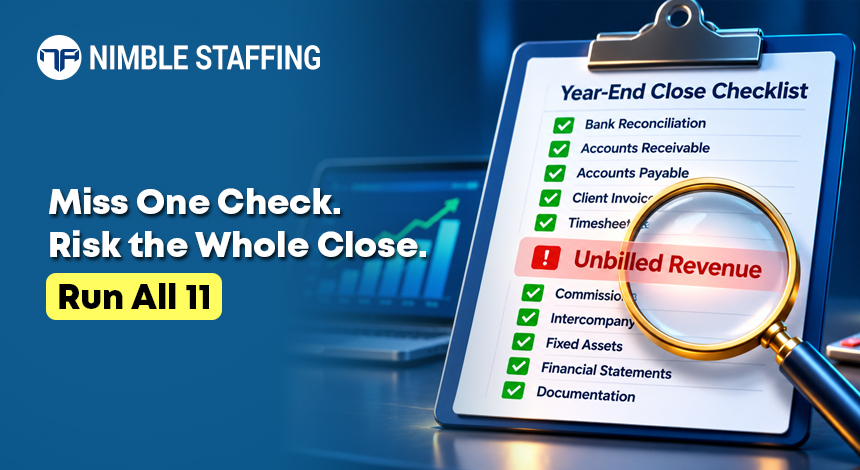
Year-End Close Checklist: Quick Reference
Use this summary to track completion across all close tasks. Detailed guidance for each item follows below.
| Year-End Close Task | Complete |
|---|---|
|
Bank and credit card accounts reconciled |
☐ |
|
Accounts receivable reviewed and aged |
☐ |
|
Accounts payable reviewed |
☐ |
|
Client invoices and payments reconciled |
☐ |
|
Outstanding timesheets reviewed |
☐ |
|
Unbilled revenue and revenue cut-off confirmed |
☐ |
|
Consultant expenses reviewed and allocated |
☐ |
|
Commission liabilities reconciled |
☐ |
|
Intercompany transactions reconciled |
☐ |
|
Fixed assets, accruals, and prepaids reviewed |
☐ |
|
Financial statements reviewed |
☐ |
|
Supporting documentation organized |
☐ |
|
Reconciliations and audit trail documented |
☐ |
|
Outstanding close issues resolved |
☐ |
Why Year-End Close Is Especially Challenging for Staffing Firms
Staffing companies manage high transaction volumes across multiple clients, consultants, and billing cycles. The interconnections between timesheets, billing, payroll, accounts receivable, accounts payable, and accounting entries make accurate reconciliation both critical and time-consuming.
Common challenges include:
- Unauthorized or incomplete timesheets
- Unbilled services rendered before year-end
- Overdue or disputed receivables
- Unpaid consultant and vendor fees
- Unreconciled sales and recruiter commissions
- Revenue and expense cut-off timing issues
- Multiple legal entities or divisions
- Intercompany transaction discrepancies
The 11-Step Year-End Close Walkthrough
1. Reconcile Bank and Credit Card Accounts
Compare all accounting records against bank and credit card statements line by line. Look for unrecorded transactions, duplicate entries, outstanding checks, deposits in transit, unposted bank fees, and any unexplained balance differences. Resolve all material discrepancies before finalizing the books.
2. Review Accounts Receivable
Analyze open and past-due invoices, credit notes, unapplied payments, long-outstanding receivables, and client payment history. Investigate any aging balances that appear anomalous. Determine whether adjustments such as write-offs or provisions for bad debt are required before the year closes.
3. Review Accounts Payable
Examine past-due vendor bills, accrued expenses, duplicate invoices, recurring expenses, consulting fees, and any unpaid vendor invoices. Pay particular attention to expenses incurred during the fiscal year that have not yet been billed or paid, and these must be accrued to ensure the correct accounting period is recorded.
4. Reconcile Client Invoices and Payments
Staffing firms should review the complete billing cycle in the correct sequence:
Timesheet → Approval → Invoice → Billing → Payment → Accounting
Check for:
- Timesheets that are approved but not yet billed
- Invoices without attached or matched timesheets
- Inaccurate billing data or rate mismatches
- Invoices that are partially paid or not paid at all
- Duplicate invoices
- Credit adjustments have not yet applied
This reconciliation identifies discrepancies before financial statements are finalized and is one of the highest-value steps in the staffing year-end close.
5. Review of Outstanding Timesheets
Timesheets are the source record for staffing revenue. Before closing the year, check for missing timesheets, unapproved timesheets, timesheets that are approved but unbilled, and any discrepancies between timesheet records and invoiced amounts. Finance teams should confirm that the financial records accurately reflect all services rendered before the year-end date.
6. Confirm Revenue Recognition and Cut-Off
Revenue must be recognized in accordance with applicable accounting standards and the terms of each client contract. Review client contracts, consultant hours, service dates, billing terms, billed and unbilled income, credits, and cut-off adjustments. Revenue cut-off errors recognizing revenue in the wrong period are among the most common staffing year-end mistakes. Consult financial specialists as needed, since treatment may vary based on contract structure and applicable regulations.
7. Review Consultant Expenses
Review travel, equipment, benefits, reimbursements, and other engagement-related costs. Confirm that:
- All submitted expenses are tracked and recorded
- Payments have been processed or are correctly accrued
- Outstanding costs are identified and provided for
- Expenses are allocated to the correct project or client
- Supporting documentation is on file for all material items
Expenses reported close to year-end require careful cut-off review to ensure they are recorded in the correct accounting period.
8. Reconcile Commission Liabilities
Sales commissions and recruiter fees are often significant liabilities at year-end. Review commission rates, accruals, modifications, claw backs, qualifying placements or billings, and paid versus unpaid commission balances. Commission schedules should align with accounting records, and all earned but unpaid commissions must be properly accrued before the books close.
9. Reconcile Intercompany Transactions
For staffing firms operating multiple legal entities, reconcile intercompany invoices, fund transfers, shared expenses, management charges, and intercompany receivables and payables. All corresponding balances between entities must be reconciled and well-supported before consolidation. Unresolved intercompany differences can distort consolidated financial reporting.
10. Review Fixed Assets, Accruals, and Prepaids
Check the fixed asset register for additions, disposals, depreciation, transfers, and any items that should be capitalized rather than expense. Review prepaid expenses (insurance, software subscriptions, professional services, rent) and accruals (bonuses, payroll-related expenses, consulting services). Older balances on the balance sheet should be scrutinized to confirm they are still valid and accurately stated.
11. Review Financial Statements
Once all reconciliations and adjustments are complete, review the balance sheet, income statement, cash flow statement, trial balance, general ledger, AR aging, and AP aging reports. Compare current-period figures to prior-year results and budget. Investigate any significant or unusual variances before the year is formally closed.
Revenue Leakage: The Hidden Year-End Risk
Revenue leakage occurs when money that should have been billed or collected is overlooked, delayed, or incorrectly recorded. For staffing firms, this is one of the most common and most underestimated financial risks. Year-end closing is the most important opportunity to identify and close these gaps.
Common sources of revenue leakage in staffing include:
- Consultant hours worked but not billed
- Incorrect billing rates applied to one or more consultants
- Reimbursable expenses missed or not invoiced
- Contractual charges with no corresponding invoice
- Billing discrepancies between timesheet records and client invoices
- Client payments received but not correctly applied to outstanding invoices
Even a small leakage rate compounds significantly at scale. A staffing firm generating $50 million in annual revenue with a 2% leakage rate is losing $1 million that could go directly to the bottom line. The year-end close is the right moment to identify these patterns and improve
How to Prepare Your Staffing Firm for an Audit
Audit readiness is a natural outcome of a well-executed year-end close. The core requirement is a comprehensive, organized audit trail: financial statements, reconciliations, transaction records, and supporting documentation that allow an auditor to trace any entry back to its source.
Essential audit documentation for staffing firms includes:
- Bank and credit card reconciliations
- Accounts receivable and accounts payable aging reports
- Intercompany reconciliations
- Commission schedules and supporting calculations
- Accrual schedules with supporting documentation
- Fixed asset register and depreciation schedules
- Invoice and payment records
- Supporting documentation for significant transactions and adjustments
A robust audit trail should answer four questions for any entry: What was recorded? Why was it recorded? What supports it? Who reviewed and approved it?
Five Common Year-End Close Mistakes - and How to Avoid Them
- Starting too late. Begin reconciling and chasing open items well before year-end.
- Relying on manual reconciliation. Spreadsheets and email add errors and version problems as volume grows.
- Missing post-year-end invoices. Late invoices may belong to the prior year, so review each one.
- Inaccurate commissions. Reconcile commission schedules, billing records, and accounting entries from one source.
- Incomplete intercompany reconciliation. Agree every balance before the close is final.
How Automation Makes Year-End Close Faster and More Accurate
Automation does not replace accounting judgment, but it dramatically reduces the volume of repetitive, time-consuming work that slows year-end close. By handling data consolidation, reconciliation, and reporting automatically, finance teams can focus on exceptions, analysis, and decisions rather than manual data gathering.
✔ Automated Reconciliation: Continuously matches accounting records to transactions, flagging discrepancies throughout the year rather than surfacing them all at year-end.
✔ Bulk Invoice Generation and AR Visibility: Converts approved timesheets into invoices automatically, maintains real-time AR aging dashboards, and tracks outstanding balances across all clients and entities.
✔ Consultant-Level P&L Reporting: Tracks revenue, costs, and margin at the individual consultant level making it far easier to identify unbilled work, margin leakage, and misallocated expenses.
✔ Centralized Documentation: Stores all supporting schedules, reports, and reconciliations in one organized location simplifying audit support and speeding up year-end document preparation.
✔ Multi-Company Consolidated Dashboards: Gives finance leaders a real-time view across all legal entities, simplifying intercompany reconciliation and consolidated financial reporting.
Conclusion: A Clean Close Starts Before Year-End
The most effective year-end closes are built on financial hygiene maintained throughout the year, not rushed reconciliations in the final weeks of December. Staffing firms that reconcile regularly, maintain clean billing records, track commission liabilities in real time, and keep audit-ready documentation year-round will find the close faster, less stressful, and more accurate.
Nimble staffing supports this approach by bringing accounting, billing, AR, payroll, consultant tracking, and compliance reporting into a single platform, so the data your finance team needs at year-end is already organized, reconciled, and ready when it matters most.
Stop finding unbilled revenue after the books close
Discover how Nimble Staffing can streamline your year-end close, improve financial visibility, and keep your staffing firm audit-ready year-round.
Schedule your demo at nimblestaffing.net
Frequently Asked Questions
1. What is a year-end financial close for a staffing firm?
It is the process of reviewing, reconciling, and finalizing all financial records at fiscal year-end, covering AR, AP, revenue recognition, timesheets, invoices, commissions, intercompany transactions, accruals, and financial statements.
2. Why is year-end close especially important for staffing firms?
High transaction volumes and tight links between timesheets, billing, and accounting mean small errors compound. The close is the best chance to catch discrepancies, address revenue leakage, confirm cut-off, and produce statements that reflect the year accurately.
3. What should staffing firms reconcile at year-end?
Bank and credit card accounts, AR, AP, client invoices and payments, timesheets, commissions, intercompany accounts, and key balance sheet items such as prepaids, accruals, and fixed assets.
4. How can staffing firms avoid year-end close delays?
Treat close as a continuous process: monthly reconciliations, firm billing cut-offs, prompt review of open items, organized documentation, and automation.
5. How does automation support staffing year-end close?
It reduces repetitive reconciliation, gives real-time visibility of invoices and AR, consolidates data across entities, and organizes supporting documents, so finance reviews exceptions instead of re-entering data.
6. What records should a staffing firm keep for an audit?
Financial statements, reconciliations, AR and AP aging, invoice and payment records, commission schedules, intercompany reconciliations, accrual schedules, the fixed asset register, and support for significant adjustments, all traceable to source.