Running one staffing company is complicated enough. Running several under the same ownership multiplies that complexity fast.
Depending on region, business line, customer segment, or acquisition history, a staffing company may operate under multiple legal entities. One entity may hire consultants, while another manages client contracts and provides administrative or shared services. While these businesses often have separate legal and accounting structures, they share consultants, clients, vendors, technology, and day-to-day operations.
As a result, intercompany accounting matters so much for staffing organizations specifically. Staffing companies need to record transactions between related entities correctly, eliminate duplicate revenue and expenses, maintain correct balances, and provide trustworthy financial statements produce financial statements that hold up both the individual-entity and consolidated level
But for staffing firms, intercompany accounting isn’t a standalone bookkeeping exercise. It’s directly tied to consultant management, timesheets, payroll integration, billing, commissions, vendor payments, and compliance reporting. Get the operational data wrong, and the accounting will be wrong too – no matter how disciplined the finance team is.
This is where a staffing-specific platform like Nimble Staffing may give a significant operational advantage.
Nimble Staffing is built specifically for staffing firms and integrates post-hire processes such as consultant management, compliance, commissions, and cash flow into a single platform. Its features include real-time multi-corporation dashboards, consultant-wise profitability, bulk invoice production, multi-model commission management, consultant portals, employee allowances, and compliance reporting.
How Intercompany Accounting Works in Practice
Before financial statements are finalized, every intercompany transaction needs to be systematically recorded by the parties involved and reconciled.
Intercompany transactions may result in erroneous reporting on revenue, costs, cash positions, receivables, payables, and profitability if disciplined procedures are not followed.
Why Does Intercompany Accounting Matter So Much for Staffing Firms?
Staffing companies carry more operational complexity in their financials than many traditional businesses. Individual consultants, clients, assignments, timesheets, suppliers, salespeople, commissions, wages, and expenses are all related to revenue and expenses. When different personnel entities work together, the complexity grows.
Consider a consultant who works on a client engagement managed by one legal entity while their payroll or administrative costs are handled through another. That single consultant can generate financial activity across multiple entities, which makes accurate recording and reconciliation essential.
Generic accounting technologies can record the final financial transactions, but staffing companies need visibility into the operational activities that result in those transactions.
That visibility is hard to get when the accounting system does not provide staffing-specific capabilities such as consultant-wise profitability, centralized consultant records, multi-model commission management, staffing-focused dashboards, and automated invoice generation. Without this operational visibility, finance and leadership teams may have to rely on multiple systems or manual processes to connect staffing activity with financial results.
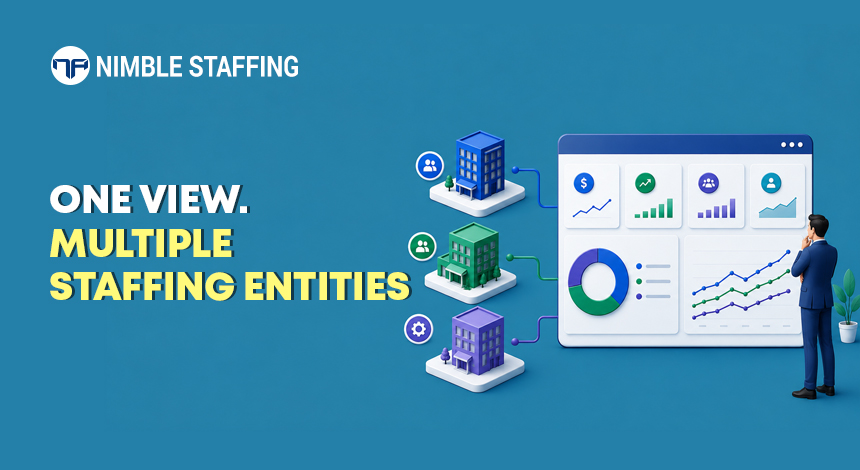
Nimble Staffing’s Unified Dashboards are intended to deliver real-time multi-entity insights into financials, staffing KPIs, and trends in a single view. For companies running several staffing entities, that kind of consolidated visibility makes a real difference.
How Does Nimble Staffing Help with Staffing Operations across Multiple Entities?
Although intercompany accounting itself is a financial discipline, the quality of the accounting is largely dependent on the operational data that the financial system receives.
Nimble Staffing’s staffing-first features can help a multi-entity accounting process.
- Single Real-Time Dashboards for Multiple Entities
For a multi-entity staffing organization, visibility is one of the most crucial criteria. Nimble Staffing offers real-time multi-corporation dashboards that present financial information, staffing KPIs, and trends in a consolidated view. Leadership may use unified data to comprehend the larger business rather than examining each entity separately.
- Profitability via Consultants
Staffing profitability ultimately comes down to people assignments, clients, billing rates, expenses, and utilization. Nimble staffing lets organizations track revenue, cost, and margin by consultant, giving multi-entity firms a way to examine profitability across the whole consultant population while still preserving entity-level financial reporting.
- Consultancy Centre
Managing several staffing entities can leave consultant information scattered and disorganized. Nimble Staffing’s Consultant Centre brings profiles, documentation, and history onto one screen. When staffing activities involve numerous companies, a consolidated consultant record can help reduce administrative redundancy and increase visibility.
- Bench Resource Management
A consultant between assignments still costs the staffing company money. Nimble Staffing delivers real-time active/inactive status throughout the roster, enabling better bench resource management and faster redeployment. Management may learn where personnel capacity is available within the company with the use of this operational visibility.
- Multi-Model Commission Management
When multiple entities, salespeople, clients, and payment agreements are involved, commission calculations can get convoluted. Nimble Staffing offers commission models based on invoices and receipts for multiple parties, reducing reliance on spreadsheets and giving finance a more systematic, standards-aligned way to manage commission calculations.
- Bulk Invoicing.
Billing volume rises rapidly as a staffing business grows and generating invoices by hand for hundreds of consultants can lead to delays and mistakes. Nimble Staffing can create client invoices in bulk from approved timesheets and provides automated reminders.
Automation may be especially helpful for multi-entity organizations when billing procedures need to be replicated across multiple operating companies
- Management of Employee Allowances
Allowances for employees and consultants add another layer of complexity to cost management and personnel payments. Nimble Staffing offers customisable allowances for housing, travel, and phone expenses on a per-employee or per-consultant basis, with allowances disbursed alongside wages, helping companies keep pay-related costs consistent across the workforce.
- Documentation and Compliance
Additionally, multi-entity staffing companies must handle documentation and compliance.
Nimble Staffing offers a document management system with eSignature support for contracts, NDAs, and onboarding paperwork, alongside DOL-compliant, certified LCA reporting. These capabilities support the operational side of maintaining compliant personnel records, while finance teams focus on accurate financial reporting.
Example: A Multi-Entity Staffing Scenario.
Consider a staffing group made up of three entities:
- Staffing Entity A – Manages technology staffing client relations
- Staffing Entity B: employs consultants
- Services Entity C: provides centralized administrative services
A consultant hired and managed by Entity B is assigned to a client engagement owned by Entity A. Here is how that single assignment flows through the system:
- 1Consultant submits a timesheet
- 2Timesheet is approved
- 3Entity A bills the client
- 4Entity B records the consultant-related cost
- 5The intercompany relationship between Entity A and Entity B is recorded
- 6Entity C allocates its applicable administrative service costs
- 7Commission is calculated for the relevant salesperson or stakeholders
- 8Entity-level profitability is reviewed
- 9Intercompany balances are reconciled
- 10Consolidated financial reporting is prepared
The financial transaction never happens in isolation. It starts with a consultant working on client engagement, and that activity eventually flows into billing, costs, commissions, and financial reporting.
That’s why staffing firms need to connect their day-to-day operations with their financial management. When these two sides are disconnected, it becomes harder to understand where revenue is coming from, where costs are building up, and how each entity is performing.
Conclusion
Managing multiple staffing companies is about more than keeping separate accounting for each firm. Consultants, assignments, timesheets, billing, payroll integration, commissions, expenses, compliance, intercompany transactions, and profitability all are connected. The financial foundation for appropriately depicting transactions between linked organizations is provided by intercompany accounting. However accurate accounting starts with accurate operational data. If the information coming from timesheets, consultants, billing, or commissions is incomplete or inconsistent, it can eventually affect the financial reports as well.
This makes a staffing-specific technology platform especially valuable.
In a platform built around staffing operations, Nimble Staffing combines consultant management, profitability monitoring, multi-corporation dashboards, commission models, bulk invoicing, consultant self-service, compliance, allowances, and document management in one platform.
Organizations that build a connected financial and operational foundation early will be far better positioned to scale without letting accounting complexity impede development as staffing businesses grow through additional customers, consultants, locations, and legal entities.
Balancing the accounts is not the only objective of multi-entity accounting. Its goal is to produce a single, reliable financial perspective of the entire staffing industry while protecting the accuracy and responsibility of each individual organization.
Bring Every Staffing Entity into One View
Nimble Staffing combines staffing operations and financial insights into a single platform, giving leadership a clearer view of each entity while making it easier to understand the performance of the organization as a whole.
Explore Nimble Staffing
Frequently Asked Questions
1. What does intercompany accounting mean for Staffing firms?
Intercompany accounting is the practice of recording, tracking, and reconciling financial transactions between related staffing entities. It supports reliable consolidated financial reporting while maintaining accurate accounting at the individual-entity level.
2. What are the problems that staffing firms encounter when managing various entities?
Common challenges include tracking consultant costs, timesheets, payroll, billing, commissions, and vendor payments, along with maintaining compliance, visibility into profitability, and accurate intercompany transactions, across several legal entities at once.
3. How is financial visibility enhanced by multi-entity accounting?
Leadership can better understand the performance of individual staffing firms and the company thanks to multi-entity accounting, which offers both entity-level and aggregated financial information.
4. How does intercompany accounting differ from consolidated accounting?
Intercompany accounting reconciles transactions between entities; consolidated accounting rolls those up into one set of statements, eliminating double-counted balances.