For staffing businesses, invoicing can appear easy until one consultant works overtime, another works at different pay rates, and a third works across state lines.
A timesheet is now more than a record of hours worked. It becomes a calculation involving multiple rates, overtime regulations, state laws, client agreements, and billing conditions.
When these computations are performed manually or across disconnected systems, even small errors might create costly problems.
Nimble Staffing helps staffing firms bring these financial workflows together.
When "40 Hours" Fails to Tell the Whole Story
A consultant logs 46 hours a week. On paper, that looks like a simple calculation. In practice, it rarely is.
Those 46 hours might break down into:
- 40 regular hours
- 6 overtime shifts
- A different pay rate depending on the tasks performed
- A different bill rate for the client
- State-specific criteria for overtime
- Contract-specific billing terms that don’t match the state default
quickly. One outdated rate in a spreadsheet. One overtime regulation is overlooked. One state has an inaccurate mapping.
The result is inaccurate invoices, delayed payments, margin leakage, and redundant reconciliation tasks.
The Real Challenge: Billing Rules are Rarely One-size-Fits-All.
Staffing agencies work in an environment where billing standards differ by consultant, client, role, location, contract, and even hours worked.
- The Calculation Changes Over Time
Overtime is more than just “hours × rate.”
Regular and extra hours for a consultant may need to be computed separately, depending on applicable laws and the client’s agreement.
For instance:
Typical: 40 hours × $50 per hour
Overtime: 6 hours × the applicable overtime rate
If the system does not automatically separate certain hours, billing teams may be required to manually identify and compute them, increasing the likelihood of mistakes.
- Additional Layer: Different Pay and Bill Rates
Depending on the job, a single consultant may charge varying fees.
For example:
| Hours | Work Type | Pay Rate | Bill Rate |
|---|---|---|---|
|
20 |
Standard |
$45/hr |
$75/hr |
|
15 |
Specialized |
$55/hr |
$90/hr |
|
5 |
Overtime |
Rate-dependent |
Rate-dependent |
That goes beyond a straightforward timesheet computation.
The system must comprehend which hours fall under which rate and why.
- Multiple States Make Compliance More Complicated.
A staffing company may assign consultants across multiple states, where applicable labor and overtime requirements can differ.
A consultant operating in one state could be subject to different regulations than a consultant operating in another.
The situation is more complicated for staffing firms that oversee a dispersed workforce:
“How many hours did they work?”
It is:
“Which hours were worked, for which client, under what conditions, and at what rate?”
That distinction can affect invoicing, payroll integration, profitability, reporting, and compliance processes.
What Takes Place When Billing Is Handled Manually?
Spreadsheets, payroll systems, billing platforms, emails, and manual calculations are all used by many staffing companies to handle these difficulties.
This leads to an additional issue: the data is not always consistent. One rate in a spreadsheet can be visible to a billing team.
The payroll team may be working with another.
Meanwhile, the client contract may specify different terms. When someone finally finds the difference, the team must trace the computation backward.
This starts an expensive cycle:
Timesheet → Manual Review → Rate Validation → Calculation → Invoice → Reconciliation → Correction
For growing staffing firms, this approach can consume significant time and create unnecessary opportunities for errors.
Nimble Staffing: Bringing the Billing Logic Together
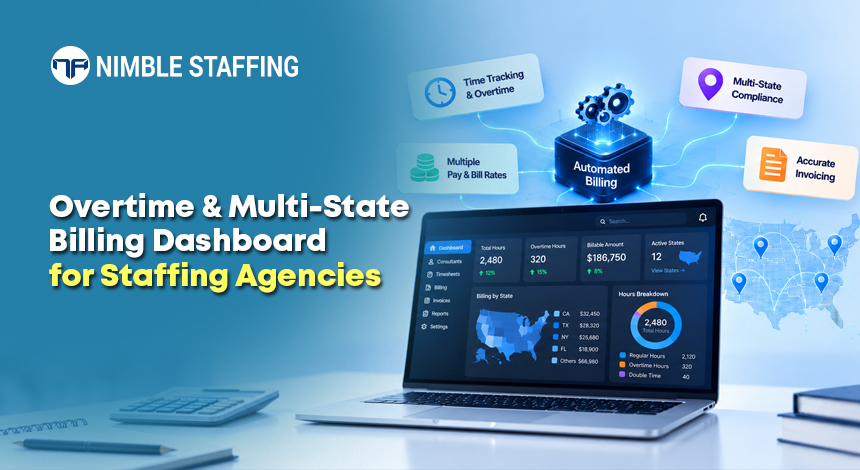
Nimble Staffing helps staffing companies manage the financial complexity of connecting consultants, clients, timesheets, billing, invoicing, payroll integration, and financial reporting within a single, more integrated workflow.
Instead of treating billing as an independent computation, Nimble Staffing contributes to a more integrated financial workflow.
For example:
A consultant working 46 hours across multiple states and billing categories can be processed through a consolidated billing workflow, with applicable rates, overtime calculations, and billing classifications applied based on configured rules.
Automate Calculations Based on Rates
Different pay and bill rates may be configured with in the system, avoiding the need for manually maintained spreadsheets. This helps teams apply the appropriate established rate to the appropriate hours and assignment more consistently.
Manage Overtime More Dependably
Overtime hours can be identified and handled according to established business and billing procedures, helping reduce the risk of missed or incorrectly calculated overtime charges. Overtime thresholds are configured by the staffing firm to reflect applicable state rules and client agreements, and once a consultant’s hours cross that threshold, the system separates regular and overtime hours automatically instead of leaving that split to manual review.
Supports Multi-State Activities
When staffing organizations operate across multiple states, monitoring consistent visibility into consultant, timesheet, billing, and financial information becomes increasingly important. Nimble Staffing maintains state-level billing and payroll rules, so consultants are billed and paid according to the requirements that apply in their state, including relevant labor and DOL compliance considerations.
Nimble Staffing helps bring this information together so billing teams can work with greater consistency and visibility while applying their established billing processes.
Connect Billing to the Overall Financial Picture
Creating an invoice is only one part of the billing process.
Billing information can affect:
- Recognizing revenue
- Account Receivables
- The profitability of consultants
- Client profitability
- Cash flow
- Financial Reports
- Gross Margins
When billing information flows into the broader financial system, staffing leaders can see more than whether an invoice was created. They can understand how that invoice contributes to the company’s overall financial performance.
From "Did We Bill Correctly?" to "Do We Know Why We Billed This Amount?"
Modern staffing firms need more than an invoice total.
When a billing manager reviews an invoice, they might be able to track:
Consultant → Assignment → Hours → Rate → Overtime → Client Agreement → Bill → Revenue
Instead of searching through multiple platforms and spreadsheets, connected financial data can make it easier to understand how an invoice was calculated and where the underlying information came from.
This can reduce manual investigation, simplify reconciliation, and help teams resolve billing questions more efficiently.
The Greater Advantage: Safeguarding Your Profits
Not every billing mistakes result in clear losses.
Often, they are hidden in small discrepancies:
- An overtime hour that was incorrectly invoiced
- A premium rate that was missing
- An incorrect state or assignment classification
- An outdated contract rate
- Hours assigned to the incorrect billing category
- A difference between client billing information and payroll data
One tiny mistake may not seem significant. However, increase that by hundreds of consultants and thousands of hours, and the impact may be significant. Accurate billing is therefore more than an operational requirement.
It is a margin-protection strategy
In Conclusion:
Billing teams shouldn’t need to become spreadsheet investigators to handle overtime, multi-rate, and multi-state billing. The appropriate technology can reduce manual calculations, connect critical financial information, improve billing consistency, and give staffing leaders greater confidence in their numbers.
By streamlining the financial complexity that follows placement, Nimble Staffing helps staffing companies spend less time resolving billing issues and more time focusing on growth.
Ready to Take the Complexity Out of Staffing Billing?
Find out how Nimble Staffing can help your team streamline billing, improve financial management, and manage staffing operations with greater confidence.
Work leaner. Run faster. Grow steadily.
Frequently Asked Questions
1. Why is it difficult for staffing firms to bill overtime?
Billing for overtime involves more than just multiplying hours by a rate. Overtime hours may need to be computed individually, frequently at various billing and compensation rates, depending on the customer, contract, and state rules. Errors in billing, late payments, and decreased profitability might result from manual computations.
2. How does Nimble staffing manage multi-rate billing?
Depending on the nature of the work, assignment, client agreement, and consultant responsibilities, Nimble Staffing helps teams apply the appropriate pay and bill rates to the relevant hours. This guarantees that the relevant rates are applied to the appropriate hours without depending on human spreadsheets.
3. Can Nimble staffing support staffing companies operating across multiple states?
Yes. Nimble Staffing assists staffing organizations in managing financial and personnel data across various states, making it simpler to navigate varied overtime restrictions, labor regulations, and billing requirements while preserving consistency and visibility.
4. What issues could manual billing procedures cause?
Manual billing frequently employs spreadsheets, payroll systems, emails, and several billing platforms. This can lead to inaccurate data, wrong invoicing, missing overtime charges, out-of-date contract rates, reconciliation delays, and margin leakage, all of which have an impact on profitability.
5. How does Nimble staffing increase billing accuracy and financial visibility?
Nimble Staffing integrates consultants, timesheets, billing, payroll, invoicing, and financial reporting into a single solution. This enables staffing firms to automate computations, increase billing accuracy, measure profitability, maintain margins, and acquire a better understanding of how each invoice affects overall business performance.