
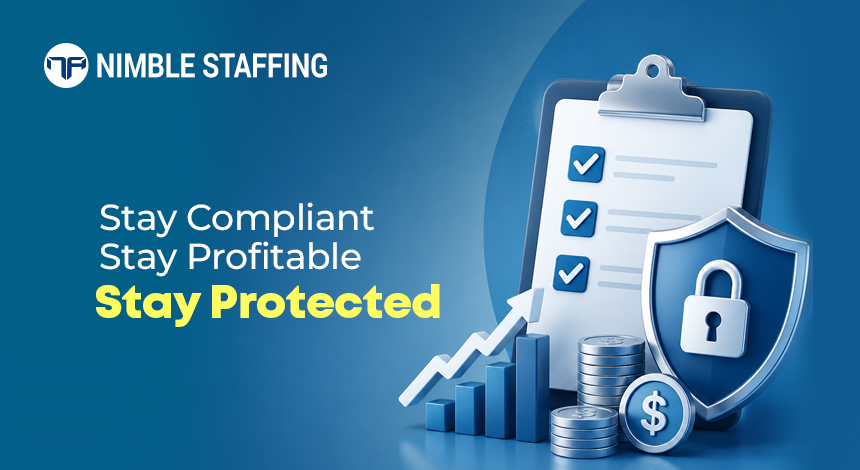
Compliance is no longer just a back-office task for staffing firms. In 2026, increasing regulations, evolving labor laws, stricter client requirements, and growing data security demands have made it a function that directly affects profitability, client trust, and long-term growth.
A single compliance gap can lead to IRS audits, costly penalties, delayed payments, legal disputes, or the loss of a key client contract. Whether your firm places contract employees, consultants, temporary workers, or direct hires, managing staffing compliance requires ongoing oversight across invoicing, consultant documentation, taxation, financial reporting, contracts, and data security. This staffing compliance checklist provides a comprehensive and actionable framework to help staffing firms maintain compliance throughout their operations year-round.
A staffing compliance checklist is a structured framework that helps staffing firms manage regulatory requirements, consultant documentation, invoicing controls, financial reporting obligations, and data security policies. By implementing a consistent compliance process, staffing firms can reduce risk, improve operational efficiency, and strengthen client confidence.
Why Compliance Is a Year-Round Priority for Staffing Firms?
Unlike many businesses that operate under single, consistent set of laws, staffing firms must manage multiple levels of compliance simultaneously, and those requirements increase with every new state or industry they serve.
Staffing Financial Compliance Requirements
Typically, staffing companies oversee compliance in the following areas:
- Federal labor laws.
- State labor laws
- Tax reporting obligations
- Client-specific contractual duties.
- Requirements for visa and work permit.
- Financial reporting standards.
- Regulations for data privacy and security.
It gets even more complicated when a staffing company is working in many different states or with clients in different industries because each one has its own set of rules.
The Real Cost of Non-Compliance
Staffing firms that fall behind on compliance risk more than just fines. The consequences can include:
| Potential Consequences of Non-Compliance |
|---|
|
• IRS tax penalties and financial fines |
|
• Wage and hour disputes with workers or contractors |
|
• Client billing conflicts and invoice disputes |
|
• Failed audits and delayed payments |
|
• Contract termination by key clients |
|
• Reputational risks that can affect long-term growth |
|
• Ongoing legal liability |
Even seemingly minor issues – an incorrect billing rate or a missing document can escalate into serious compliance violations if left unchecked.
How automation reduces compliance risk?
Purpose-built Staffing accounting software is designed to support industry compliance standards across finance operations, maintain billing accuracy, support labor law compliance, and automate compliance controls for broader legal and regulatory requirements.
Automation benefits businesses:
- Validate timesheets before invoices are generated
- Automatically applies contract-approved billing rates per client contract
- Monitor visa and work authorization expiry dates proactively
- Maintain complete, timestamped audit trails on every transaction
- Generate compliance reports instantly for any period
- Enforce role-based access controls on sensitive financial data
- Keep financial records accurate and reconciled in real time
Rather than depending on spreadsheets and manual assessments, staffing businesses may implement proactive compliance controls that run continually.
Complete Staffing Compliance Checklist for 2026
To assess your company’s compliance preparedness, use the following checklist.
1. Billing and Invoicing Compliance
Maintains accurate billing is an integral part of the staffing firm compliance requirements. Errors here directly impact on revenue recognition, client relationships, and audit outcomes.
- All invoices match approved timesheets – difference between actual invoiced and approved hours is a leading problem in client disputes and audit inquiries. Cross-check the authorized hours, including overtime calculations, holiday billing, and specific-project allocations.
- Client-specific billing rates are correctly applied Many clients often negotiate distinct rates for regular hours, overtime, holidays and specialized skill sets. Incorrect rate application leads to revenue leakage or client disputes
- Invoice numbers are sequential and traceable – Invoice numbers need to be consecutive, unique. This maintains financial integrity and simplifies reconciliation during audits
- Credit notes are properly documented, when invoices are adjusted, maintain detailed records that show the original invoice, reason for adjustment, approval records, and updated invoice details. This protects the firm during client audits and financial evaluations.
2. Consultant and Contract Compliance
Managing consultants across multiple client engagements creates a wide range of compliance obligations that must be actively tracked and documented.
- Signed contracts are on file for every placement – we need to have a signed employment contract, a services agreement, and client-specific assignment documents. Missing paperwork leads to legal problems and compliance gaps.
- Visa and work authorisation status is actively monitored – When placing international workers, we must track visa expiry dates, work authorisation renewals, and all supporting immigration documentation. If we failure to maintain records can result in severe regulatory penalties.
- Background check records are complete – Many clients require verified background checks before onboarding consultants. Documentation should include screening results, verification records, consent forms, and renewal documentation.
- NDAs and non-compete agreements are signed and securely stored – Confidentiality agreements protect both the staffing firm and its clients. Ensure all agreements are signed, readily accessible, and stored securely on a cloud-native platform.
3. Financial Reporting Compliance
Financial reporting compliance is crucial for staffing firms, because it helps to maintain strong financial controls and build investor confidence. It also prevents small errors from becoming major issues.
- Financial records, revenue transactions, accounts payable, and accounts receivable are reviewed and reconciled every month. Regular reconciliation helps identify discrepancies before they escalate into compliance issues.
- Revenue recognition policies are consistently applied – Ensure revenue is recognised in accordance with applicable accounting standards and client contract terms, particularly for multi-month or project-based.
- Accounts receivable aging is reviewed regularly, Monitor outstanding invoices and escalation timelines. Unresolved receivables are both a cash flow risk and a compliance indicator.
- Multi-entity financial reports are accurate and consolidated, Staffing firms operating across multiple legal entities or states must ensure intercompany transactions are properly recorded and reflected in consolidated financial reporting.
4. Technology and Data Compliance
In 2026 data security is a priority for compliance. Staffing firms handle sensitive personal and financial data, so they must have strong controls in place to protect it.
- Client and candidate data is protected with secure access controls, Staffing firms often manage social security numbers, banking details, and employment history. Access must be restricted based on job roles, with least-privilege principles enforced.
- Role-based access permissions are reviewed every quarter. Regular reviews help ensure that user roles and appropriate access permissions, and the deactivation of accounts for former employees. Administrative rights must be tightly controlled.
- Data retention schedules are formally documented and followed establish official retention policies, contracts, tax records, accounting documents, and client data. Retention periods must align with federal and state requirements.
- System access logs are maintained and monitored – Access logs provide visibility into login activity, data changes, approval actions, and security incidents, helping to support internal reviews during audits and investigations.
How Nimble Staffing Helps You Stay Compliant Year-Round
Managing compliance manually through spreadsheets, email chains, and calendar reminders does not scale as a staffing firm grows. Nimble staffing is purpose-built for the staffing industry, embedding compliance controls directly into everyday workflows.
| Feature | Compliance Benefit |
|---|---|
|
Automated Compliance Alerts |
Proactive notifications for visa expiry, contract renewals, invoice approval delays, and missing documentation |
|
Integrated Audit Trail |
Every transaction, approval, and update is automatically logged for complete traceability |
|
Role-Based Access Management |
Employees access only the data relevant to their role, meeting regulatory access control requirements |
|
Compliance Reporting Library |
80+ pre-built reports covering financial statements, AR aging, audit logs, and revenue analytics |
|
Real-Time Compliance Dashboards |
Live visibility into compliance status across all operations and entities |
Audit readiness is the natural outcome of consistent compliance practices. When billing records, consultant documentation, financial reports, and system audit trails are maintained continuously, staffing firms are far better prepared for internal reviews, client audits, and regulatory inspections.
Conclusion
Compliance is no longer a seasonal check box. In today’s staffing Industry, it must be embedded into daily operations financial workflows, consultant management, and technological platforms.
A structured Staffing Compliance Checklist helps firms reducing risk, improve client confidence, and preparing for audits with full preparedness. But as firms grow, compliance tracking manually becomes complex, time-consuming and increasingly prone to error.
Purpose-built staffing accounting software transforms audit readiness from a reactive burden into a proactive business benefit. Nimble Staffing helps staffing firms maintain financial and operational compliance throughout the year with automated processes, audit trails, real-time alerts, financial controls, and comprehensive reporting, freeing your team to focus on growth instead of firefighting.
Take Control of Compliance Before It Becomes a Risk
Build a stronger, more compliant staffing business with the right financial foundation. Nimble staffing provides the visibility, automation and financial control needed to reduce risk and support long-term growth.
FAQs
1. What is a staffing compliance checklist?
A staffing compliance checklist is a structured framework that helps staffing firms manage regulatory requirements, consultant documentation, invoicing controls, financial reporting obligations, tax compliance, and data security policies. It helps reduce risk, improve operational efficiency, and maintain audit readiness.
2. What are the main compliance requirements for US staffing firms?
The primary compliance requirements for US staffing firms include labor law compliance, tax reporting obligations, consultant and contractor documentation, accurate billing and invoicing, visa and work authorization tracking, financial reporting, data security controls, and client-specific contractual requirements.
3. How often should staffing firms review their compliance processes?
Staffing firms should review compliance processes continuously throughout the year. Financial records should be reconciled monthly, access controls reviewed quarterly, and formal compliance assessments conducted annually to identify and address potential risks proactively.
4. Can automation reduce compliance risks for staffing firms?
Yes. Automation helps staffing firms standardize processes, monitor compliance deadlines, validate billing data, track documentation, and maintain complete audit trails. This reduces human error and strengthens overall compliance management.
5. How does staffing accounting software help with compliance?
Staffing accounting software helps automate compliance-related processes such as invoice validation, audit trail management, financial reconciliations, document tracking, compliance reporting, and role-based access controls. This improves accuracy, reduces manual errors, and helps staffing firms maintain audit-ready records year-round.
Pingback: Intercompany Accounting for Staffing Firms | Nimble Staffing
Pingback: Multi-Rate & Multi-State Billing for Staffing Agencies