Invoicing is not simply an accounting function for staffing firms. It is a core operational process that shapes cash flow, consultant profitability, vendor relationships, and overall business health. Every delay, error, or missed billing event in the invoice cycle has a direct cost, either as lost revenue, a strained client relationship, or a payroll liability that outpaced collections.
Yet in many staffing firms, invoicing is still handled manually or across disconnected systems – a time-consuming process prone to data-entry errors, rate mismatches, and approval bottlenecks that slow the entire cash cycle down
Nimble Staffing Accounting Software helps businesses automate crucial post-hire processes related to financial operations, commissions, invoicing, compliance, and consultant management. Nimble’s bulk invoice generation from approved consultant timesheets eliminates manual billing effort, reduces errors, and accelerates the cash cycle.
Unlike general accounting solutions, Nimble integrates staffing operations and financial activities into a single staffing-specific platform.
Why Staffing Invoice Processing Is More Complex Than Standard Billing
Unlike product businesses or straightforward service firms, staffing agencies manage a continuous flow of consultants, assignments, client billing rules, payroll obligations, commissions, and compliance requirements – often simultaneously across dozens or hundreds of active placements.
A single staffing invoice may need to account for:
- Approved consultant timesheets (the source record for billing)
- Assignment and client information
- Billable hours, including overtime and holiday rates
- Client-specific or role-specific billing rates
- Expense reimbursements
- Commission structures for recruiters or account managers
- Visa and work authorization compliance documentation
- Approval status across multiple stakeholders
When these inputs are managed manually or across disconnected systems, billing teams spend significant time gathering data, entering it, reconciling errors, and chasing approvals before a single invoice is even sent. As placement volumes grow, this manual burden scales linearly and becomes unsustainable.
How Does OCR Help with Invoice Automation?
Automated invoice processing uses Optical Character Recognition (OCR) technology and rule-based automation to speed up invoice receipt, processing, and validation.
- Invoice Capture
Invoices may arrive via mail, email, vendor portals, or EDI systems. Automation tools consolidate, standardize, and regardless of source. Paper invoices are converted into digital formats through scanning and OCR, while electronic invoices can be processed directly.
- Data Extraction
OCR transforms text from scanned invoices and PDFs into machine-readable data. Important information, including vendor details, line items, pricing, invoice dates, and payment deadlines, can be identified and extracted using ML algorithms. Information that is unclear or has low confidence is immediately forwarded to staff members for review.
- Validation and Matching
Automation checks invoice data against internal records to detect duplicates, errors, inconsistencies, and potential fraud. Vendor information, such as tax IDs and bank account details, can also be verified.
Matching invoices improves accuracy even further. Two-way matching compares an invoice with its purchase order, while three-way matching additionally compares it with goods receipt notes (GRNs) to ensure that products or services were received.
Matching can be fully automated, manual, or a combination of both, depending on the organization’s level of automation maturity.
How Nimble Staffing Automates the Staffing Invoice Cycle
For staffing firms, the most impactful invoice automation is not inbound document processing it is the outbound billing cycle: converting approved consultant timesheets into accurate client invoices, quickly and at scale. This is where Nimble staffing delivers the most direct operational value.
1. Timesheet Submission via the Consultant Portal
Consultants submit timesheets through Nimble’s dedicated Consultant Portal a structured, role-specific interface where they can view assignments, access documents, monitor payroll data, and log hours against the correct client, project, and billing category. Once submitted, timesheets enter a configurable approval workflow before being passed to billing.
Structured timesheet data eliminates the reformatting and re-entry that slows manual billing cycles.
2. Configurable Approval Workflows
Submitted timesheets route through approval chains configured to match the firm’s structure by client, project type, consultant category, or billing threshold. Both internal managers and client contacts can review and approve within the platform, creating a full audit trail of every decision.
Approvals that previously took days now complete in hours, with no email chains and no lost submissions.
3. Bulk Invoice Generation from Approved Timesheets
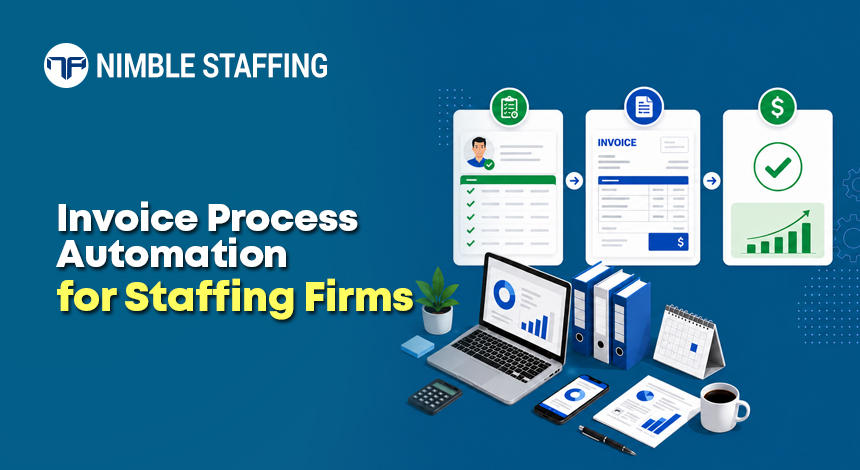
Once timesheets are approved, Nimble automatically generates client invoices in bulk applying the correct billing rules for each client and consultant without any manual input from the finance team. For staffing firms managing multiple consultants across multiple billing cycles, this step alone eliminates hours of weekly finance work.
- Applies client-specific and role-specific rate cards automatically
- Handles overtime, holiday rates, and expense reimbursements
- Supports weekly, bi-weekly, monthly, and custom billing cycles
- Invoices are accurate because they flow directly from approved source data, no transcription, no re-entry
Invoice delivery in minutes after timesheet approval, not days.
4. Automated Payment Reminders
Nimble enables automated payment reminders triggered by invoice due dates so staffing firms can follow up on outstanding invoices systematically rather than relying on finance staff to manually track and chase each account.
Collections become proactive, shortening DSO and improving working capital availability.
5. Consultant-Level Profitability Tracking
Invoice processing does not operate in isolation. Nimble links every billing event to consultant-level P&L reporting giving finance and executive teams real-time visibility into the revenue, costs, and profit margins associated with individual consultants and assignments. This makes it possible to identify which clients and placements are contributing to the bottom line, not just to top-line revenue.
Pricing and staffing decisions backed by live margin data, not end-of-month estimates
Why Use Nimble Staffing Rather Than Generic Accounting Software?
Generic accounting platforms can handle basic financial transactions, but they are not tailored to the operational needs of staffing firms. The Nimble Staffing solution, for instance, addresses several limitations of generic accounting software, such as the lack of staffing-specific dashboards, centralized consultant profiles, LCA/DOL compliance reporting, bench management, multi-model commission management, and automated invoice generation from timesheets.
The Nimble Staffing Advantage at a Glance
Nimble staffing is built around the specific operational needs of US IT staffing firms:
✔ 30% time savings through automation: Reduce administrative overhead across billing, payroll, and compliance workflows.
✔ 80+ financial and staffing reports: Access industry-specific reports instantly, covering AR aging, consultant profitability, compliance, and more.
✔ Bulk invoice generation: Convert approved timesheets into client invoices in minutes, not days.
✔ Unified Consultant Center: Every detail about a consultant assignment, payroll, documents, timesheets in one place.
✔ Multi-company capabilities: Manage multiple entities from a single consolidated platform.
✔ LCA and DOL compliance reporting: Stay audit-ready with automated compliance reports built into the platform.
Conclusion: From Manual Billing to an Automated Cash Cycle
Invoice management in the staffing industry is genuinely complex it touches consultants, clients, vendors, commission structures, compliance records, and payroll obligations simultaneously. Managing this complexity manually is slow, error-prone, and increasingly unsustainable as placement volumes grow.
Nimble staffing transforms the invoicing process by starting where staffing revenue originates: the approved timesheet. From there, automation handles bulk invoice generation, payment tracking, and profitability reporting – reducing administrative effort, eliminating billing errors, and giving finance teams the real-time visibility they need to manage cash flow proactively.
By bringing staffing operations, invoicing, profitability tracking, compliance, and reporting together in one platform, Nimble staffing helps staffing firms run a tighter, faster, and more profitable billing cycle – so teams can focus on growth rather than chasing paperwork.
See automated invoicing in action.
Book a free demo of Nimble staffing and discover how much faster your staffing firm could close the timesheet-to-cash cycle.
Frequently Asked Questions
1. What is invoice process automation for staffing firms?
Invoice process automation is the use of automated data recognition and rule-based workflows to convert approved consultant timesheets into client invoices, reducing manual data entry and billing errors.
2. How does Nimble Staffing generate invoices from timesheets?
Once a consultant timesheet is approved through the Nimble Consultant Portal, Nimble can generate the corresponding invoice or batches of invoices automatically, without a separate manual billing step.
3. What is OCR and when is it useful?
OCR (Optical Character Recognition) converts text from scanned documents and PDFs into machine-readable data. It is useful when staffing firms receive paper or digital invoices that require data extraction.
4. Can invoices be generated in bulk for multiple consultants?
Yes. Nimble supports bulk invoice generation, which is especially useful for staffing firms managing multiple consultants and overlapping billing cycles.
5. How does invoice automation reduce billing errors?
By generating invoices directly from approved timesheet data instead of manual re-entry, automation reduces common errors like mismatched rates, missed hours, or inconsistent invoice formatting.